Two ways to predict the world
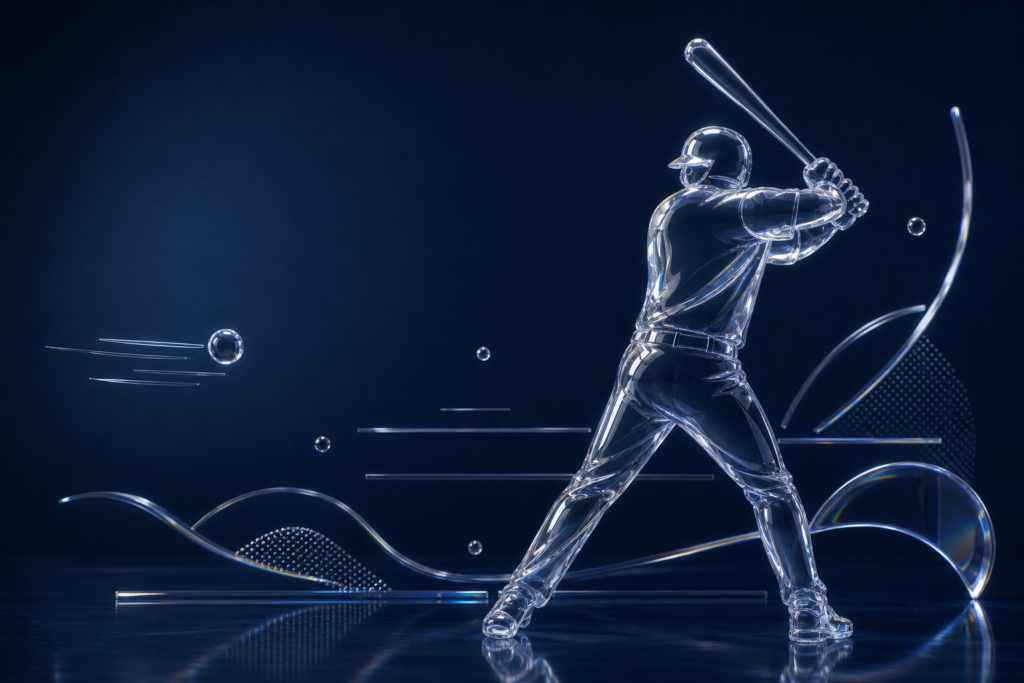
A Major League Baseball batter faces a fastball travelling at over 150 kilometres an hour. There is no time to watch the ball arrive and then react. Instead, the batter predicts where the ball will cross the plate. Then they start the swing before the ball gets there. That single act of prediction sits at the centre of one of the most consequential technologies in artificial intelligence today: world models.
Aicadium has been studying world models together with a closely related technology, physics engines. Both answer the same question. If I take this action now, what happens next? They simply answer it in different ways. Understanding that difference is becoming a strategic decision for any leader investing in robotics, automation, or autonomous systems.
The batter and the physicist
There are two ways to predict that incoming pitch. The batter predicts it from experience, having faced thousands of pitches until the read becomes intuition. A physicist predicts the same pitch from equations, taking the speed, spin, and release point and computing the trajectory. Both arrive at a useful answer. One learned it; the other calculated it.
A world model is the first kind of prediction. It is a learned, action-conditioned model of how an environment behaves, built from data rather than from rules. Give it the current situation and a proposed action, and it predicts the next situation. A physics engine is the second kind. It is software that computes how objects move and interact according to the laws of physics. It approximates forces, trajectories, and collisions over time.
The distinction matters because each approach carries different costs, risks, and strengths. A leader who treats them as interchangeable will misjudge where to invest.
What is the difference between a world model and a physics engine?
A world model learns how an environment behaves from data and predicts plausible futures. In general, they adapt well to visual variety. World models come in three paradigms, distinguished by what the model predicts. Generative, pixel-space models produce a viewable video frame at each step. They are good for synthetic data but compute-heavy and prone to drift over long sequences. Latent-space models predict in a compressed, abstract representation. They are faster, but harder to interpret, and some produce no image at all. 3D and 4D spatial models predict explicit geometry. They compose well with physics engines but remain research-stage.
This is why “world model” is a loaded term. All three paradigms carry the label, alongside products that are really vision-language-action systems or hybrids.
A physics engine computes how objects behave from physical equations and predicts numerically grounded futures. They are more accurate for precise, contact-heavy tasks. The hardest shared problem is contact, or what happens at the instant two objects touch. We explore it in our companion piece on the sim-to-real gap.
Simulation is the shared prize
The case for simulation belongs to both technologies. A simulated system can rehearse many possible futures and choose an action before touching anything in the real world. This matters wherever real trials are slow, costly, or dangerous. The value holds whether the simulator (the simulation engine) is learned or computed. Both can also generate practice data for embodied AI training, easing an expensive and sometimes unsafe data bottleneck.
The real choice is not whether to simulate. It is a question of which kind of simulator fits the task, and that turns on four practical differences.
Where the two actually differ
Physical realism versus photorealism. A physics engine keeps the scene self-consistent and obedient to physical law, but it struggles to look real. Its realism is capped by the quality of 3D assets and rendering. A world model is fundamentally different. Its scenes can be beautifully rendered, yet they may not stay self-consistent over time. Objects can appear, disappear, or morph when the gaze shifts, and object behaviour can drift into the nonphysical.
Ease of use versus control. World models can typically be prompted into a scene. Physics engines carry an overhead of 3D asset generation, scene scripting, and rendering before anything runs. The price of the world model’s convenience is control: you cannot easily specify or pin down every detail that matters. There is also a difference in what each can start from. A world model can parse and build on real-world images and video. A physics engine needs 3D object descriptions or assets, with initial and/or boundary conditions specified.
Representation. The two describe the world in incompatible ways, and this shapes everything downstream. A physics engine’s state is physical parameters: positions, velocities, illuminant properties, and thermodynamic quantities. These have obvious meaning and can be manipulated directly and independently. A world model’s state is a latent encoding whose individual units usually have no well-defined meaning. The two afford very different downstream analysis and reasoning.
Portability. Physical parameters mean the same thing everywhere. Any engineer can interpret a position, a velocity, or a mass, whichever engine produced it. A latent state belongs to the world model that produced it. It has no meaning for another world model, or even for another version of the same one.
How well each supports policy learning remains an active research question.
Neither comes with a guarantee
Neither technology is automatically accurate about the real world, and neither offers guarantees. A physics engine is only as good as its parameters, assets, actuator and contact models, and its numerical and physical approximations. Rendering adds a further layer of error. A poorly constructed model behaves incorrectly. Even a good one fails where the physics is too complex, too chaotic, or spans too wide a range of spatial and temporal scales.
World models sit further along the same risk curve. There is no guarantee against hallucinatory or nonphysical behaviour, and they often produce futures that look plausible yet are physically impossible on closer inspection. Whichever route a team chooses, validation against reality is part of the project, not an optional extra.
Which approach should a business choose?
Neither approach wins outright, and the better question is where each fits. Visual variety, promptable setup, and synthetic data generation favour world models. Tasks that demand numerical accuracy, interpretable state, and portable scene descriptions favour physics engines. Most serious systems will combine both, a convergence we examine in the next piece in this series, Where physical AI is heading.
For leaders, the practical takeaway is to match the method to the requirement rather than to the headline. A learned model that looks convincing is not the same as a computed model that is correct but looks artificial, and neither is correct by default. Aicadium’s view is that the organisations which understand this distinction will deploy physical AI with fewer costly surprises and more durable results.
The field has crossed a tipping point
Investment signals how seriously builders now take learned prediction. A new lab co-founded by AI pioneer Yann LeCun raised over US$1 billion, the largest seed round on record for a European startup. World Labs, founded by Fei-Fei Li, raised US$1 billion in a single round, according to Crunchbase reporting. NVIDIA reports that its Cosmos world foundation models have been downloaded more than five million times. Builders are no longer experimenting at the margins. They are shipping.