Most documents get a skim and a gut check. Someone reads through, queries a figure or two that look off, and takes the rest at face value because the prose is confident and the citations look tidy. That worked when documents were slow to produce. It does not work now that AI drafts them in minutes, because the checking has not sped up to match, and the person who publishes or reuses a document still answers for every claim in it.
We built EMBER (Evidence Mapping and Benchmarking of Existing Research) to help us run a complete check on a document. You hand it a finished document, it works out what the document claims, checks each claim against sources outside the document, and returns the original text with a marker on every claim and a note on what to fix.
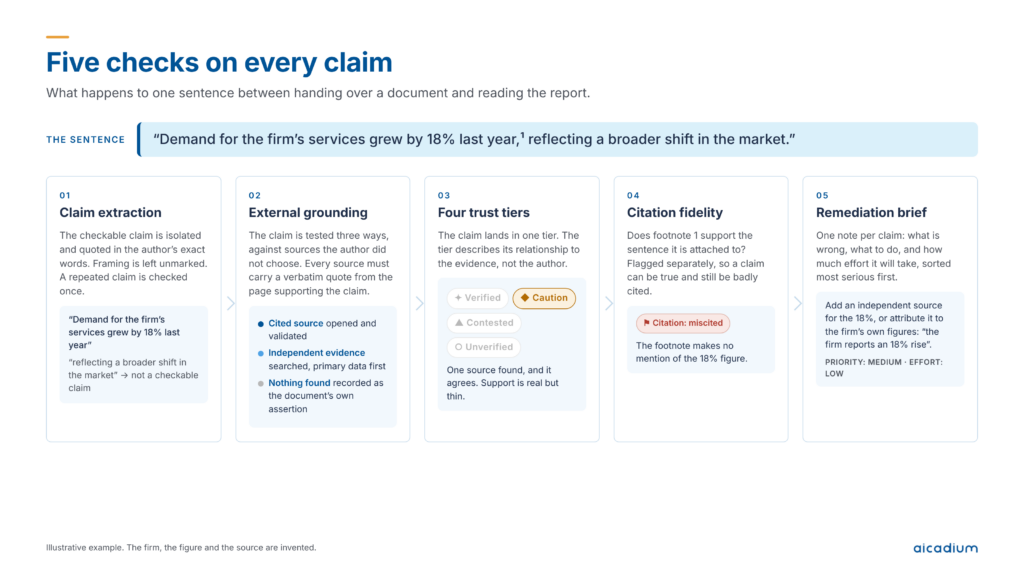
Claim extraction. EMBER pulls out every verifiable factual claim and quotes the exact words it came from. Each claim is checked once, even if the document repeats it. Opinions, framing and statements that cannot be tested are left unmarked, so a sentence with no marker is one that makes no checkable claim.
External grounding. Each claim is tested in three ways. EMBER opens the source the document cites to see whether it says what the document says it does. It then searches for independent evidence, giving more weight to primary documents and official data than to commentary. If nothing outside the document can be found, it says so rather than guessing. Every source it records has to carry a verbatim quote from the page that supports the claim; a page that cannot produce one is not counted.
Four trust tiers. Each claim lands in one of four tiers, and the tier describes the claim’s relationship to the evidence, not the author. Verified: multiple independent sources confirm the claim as written. Caution: support exists but is thin, usually a single source. Contested: credible sources disagree with the claim, or with each other. Unverified: no external evidence was found, so the claim rests on the document’s own word.
Citation fidelity. Where the document cites a source, EMBER checks whether that source supports the sentence it is attached to. A real reference can still be miscited, or broken and these are flagged separately, so a claim can be true and still carry a citation problem.
Remediation brief. A prioritised list of what to fix and how. Each item names the claim, what is wrong, what to do about it and how much effort the fix will take. Factual errors get a correction, with a source for the correction. Disputed framing gets a clarification. Unverified claims get a request for the source. Internal figures get labelled as the organisation’s own.
How to use it
Using it takes three steps. Hand EMBER the document, run the check with a single instruction, and read the report that comes back. The report is the original document, word for word, with a marker on every claim. A short summary at the top tells you how many claims were checked, how they fared, and what to fix first, so you can judge the document in a few minutes and open the detail on any claim only when you need it.
How it has held up so far
We evaluated EMBER against a 7,000-word published industry guide that had not been used during development, grading the result by hand, claim by claim. Every claim it extracted was something the document actually said; none was fabricated. Of the 34 sources it attached to those claims, 33 fully supported the claim, and one did so partially, with no false matches.
Alongside the test run, the first people to use EMBER were our own team. One ran it on a piece we had already published and found figures that had quietly gone out of date; the fixes took an afternoon, and it went back out with stronger sources. Another used it on incoming reports to decide which numbers could travel into customer briefings and which should stay where they were, with the source already attached for the ones that could.
EMBER makes a document’s claims visible as claims, each with its evidence attached and its standing marked, so the decision about whether to rely on a figure is made with the evidence in view rather than on the strength of the prose. It does not make a document true; the decision to decide between internal vs unsupported information still lies with the user. But it closes the gap we kept running into, in our own documents and in the ones sent to us, for every claim at once, rather than the few that happened to look wrong.
We have written up how the check works, the thinking behind it, and what the report looks like when it comes back.