The quiet failure no dashboard reports
Answer engine optimisation (AEO) is the practice of measuring and improving how AI assistants represent your company in the answers they generate. This piece explains what AEO is, why it matters now, and how to measure it with a framework called PRISM.
Key points
-
Buyers now ask AI assistants for recommendations, and the answer may never mention your company — and nothing in your analytics will record that it happened.
-
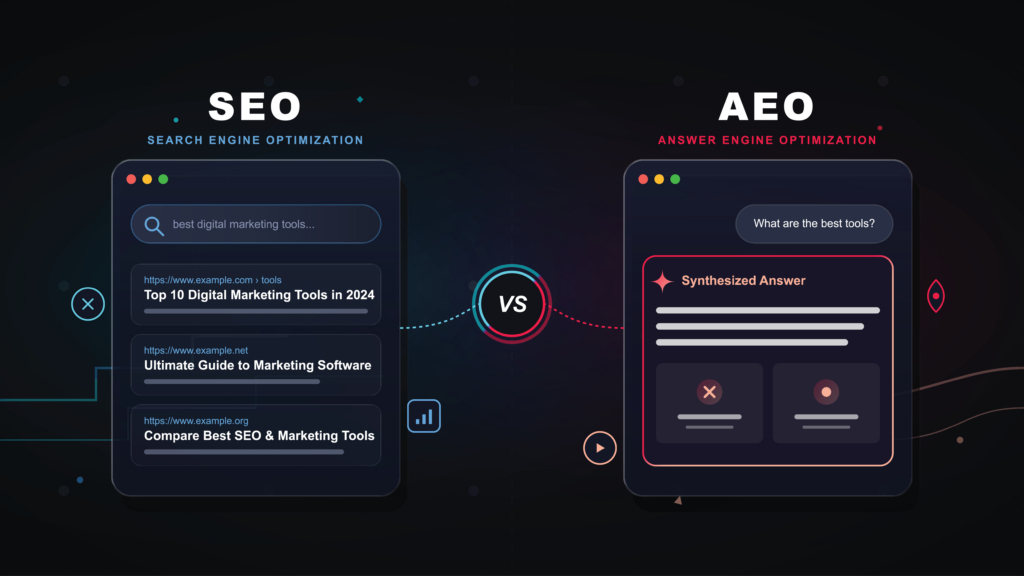
Search engine optimisation (SEO) optimises for retrieval and ranked links. Answer engine optimisation (AEO) optimises for synthesis: the single answer an assistant generates.
-
Strong SEO is necessary for AEO, but not sufficient. In our audits, only around 38% of the pages that rank in a search engine’s top ten overlap with the pages AI assistants actually cite.
-
AI visibility is fragmented across models and regions, so optimising for one model leaves you exposed elsewhere.
-
PRISM measures AI visibility across five pillars — Presence, Ranking, Insight, Sourcing, and Mapping — and combines them into a single health score.
The failure that leaves no trace
Picture a marketing review that is going well. Organic traffic is steady. The quarterly search report is healthy. Everyone in the room feels good.
Meanwhile, a potential buyer uses a chatbot to ask, ‘Who are the leading providers of the product you offer?’ The model responds with three company names. You are not one of them. The buyer moves on, and nothing in your analytics records indicates that it happened.
This is the gap that answer engine optimisation addresses.
Most teams continue to optimise metrics designed for ranked links. However, buyers now rely on synthesised answers, which require different measurement approaches.
What is answer engine uptimisation and how is it different from SEO?
Answer engine optimisation (AEO) is the practice of measuring and improving how AI assistants describe your company in their answers. It differs from search engine optimisation in one fundamental way: SEO optimises for retrieval, and AEO optimises for synthesis.
A search engine retrieves and ranks pages, presenting a list for buyers to review. Companies compete for top positions. In contrast, an answer engine generates a single paragraph in response to a question, which may not mention your company. There is no list and often no user click.
As a result, attribution becomes difficult. In search, the customer journey was traceable from keyword to conversion. With answer engines, buyers read synthesised answers, form opinions, and may contact you directly or select another provider. There is no referrer or keyword data available. Buyers may reach out with a pre-formed opinion or not engage at all.
Why an answer engine differs from a search engine
If both systems search the web, why do their results differ significantly?
This difference exists because an answer engine uses two sources and transforms the query twice. The first source is the model’s internal knowledge, based on its training data. The second is live web search through external tools. The model decides which source to prioritise.
When the model searches, it reformulates the original question into multiple sub-queries, processes them in parallel, and then synthesises the results into a single answer. These steps, known as fan-out and fan-in, are not part of traditional search and remain hidden from users.
Two additional properties are important for leaders. Answer engines are non-deterministic; the same model may provide different answers to the same question. They also enrich queries with additional context, such as conversation history, user profile, and location. As a result, identical questions can yield different answers from different users.
Why optimising for one model is not enough
Optimising for a single model leaves you exposed, because the market is fragmenting fast. According to web analytics firm Similarweb, ChatGPT’s share of generative AI web traffic fell from about 87% in early 2025 to between 60% and 65%a year later, while Gemini’s share rose from around 5% to over 21% over the same period.
Those figures understate how fragmented the market really is because the trackers behind them mostly measure English-language, Western assistants. Across much of Asia, the picture is different. Alibaba’s Qwen has become the most-downloaded open-weight model family in the world, and the base Singapore’s national AI programme chose for its latest flagship model, while homegrown systems lead in China. Optimise for one model, and you are exposed everywhere it is not the default.
Models also disagree with each other. The same company and question, tested across different models in the same week, can return different recommendations, positions, and framing. In one audit, one model left a company out of a category entirely while another recommended it with confidence. The disagreement is structural because each model is built on different training data, post-training, and search tools.
The useful inversion is that disagreement is the expected state. What should catch your attention is agreement, because agreement means a consistent picture of your brand has formed across the wider information ecosystem. That is the state worth engineering towards.
The framework: PRISM
PRISM is a framework that measures AI visibility across five pillars and combines them into a single health score. Each pillar answers a question the others cannot, and each represents a distinct way to fail:
-
Presence — Do you appear in AI answers at all?
-
Ranking — How prominent are you when you do appear?
-
Insight — Is the description of you accurate?
-
Sourcing — Which sources does the model treat as the authority on you?
-
Mapping — Can the model actually find and read your own content?
A company can be strong on one pillar and weak on another, and the remedies differ completely.
The value of a single score is governance. For a decade, a marketing leader could walk into a board meeting with three defensible numbers: rank, domain authority, and organic traffic. For AI visibility, the honest answer until recently was that nobody knew. The score is the contract; the pillars are the work.
What the audits reveal: three failure patterns
Before the patterns, one point deserves to be stated plainly: SEO is still the foundation, and AEO does not replace it. If your site is not crawlable, or your structured data is a mess, the model never gets to consider you, because you are invisible before the race starts. AI crawlers are also less forgiving than Google, which has spent years learning to parse messy markup; LLMs have not. A clean technical base is the price of entry. What the audits show is that it is the price of entry and nothing more.
Three patterns recur across the audits run so far.
The healthy-but-invisible company. Run the same query through both systems and compare the pages in a search engine’s top ten against the pages an answer engine actually cites: only around 38% overlap. The other 62% of citations come from somewhere else entirely. A page can rank well and still be unusable to a model. If it is long, heavily decorated, and built around keyword density, there is no clean passage to lift. The model wants a short, declarative chunk it can synthesise. A company can hold hundreds of high-ranking pages and still be absent from AI answers because none of them is structured for synthesis, and nothing in a standard marketing dashboard would reveal it.
Competitor substitution. A buyer asks who leads a category, and the model confidently names a competitor, even when the audited company is larger in revenue, customer count, and every other measurable metric. It picked the wrong leader, and it will keep picking it until the underlying signals shift. The cause is usually that the competitor has a stronger, more structured presence in the sources the model trusts, including reviews, listicles, analyst content. The model pattern-matches on what is said about a company, not on what is true of it.
The sourcing surprise. Even when a company shows up well, the citations supporting its claims rarely point to its own site. They point to Reddit threads, niche bloggers, analyst PDFs that may be years old, and aggregator sites the marketing team has never heard of. The company does not control its own narrative. Third parties that it cannot see or control instead. The flip side is leverage: a marketer who discovers that a single Reddit thread is shaping how models describe the company has one high-value fix to make, not a hundred incremental ones.
Taken together, these patterns describe a specific trap. The dashboard looks healthy, the traffic looks fine, and the model is still ignoring you. You do not have an AI visibility problem. You have an AI visibility problem that you cannot see.
The strategic window
There is no established benchmark for strong AI visibility yet, which creates a first-mover advantage. The company that measures first and broadly in its category helps define the standard others follow. This window is open now, but it narrows with each model update.
Retraining tends to reinforce the patterns a model has already learned. Once a model settles on the category leaders, displacing them becomes harder. This reverses the traditional search dynamic, which rewarded patience. How stable these patterns are and how quickly the window closes remain uncertain, but every model update observed so far has increased concentration around the incumbents.
The takeaway for leaders is clear. Executive committees now ask, “What is our AI visibility?” The only question is whether you have an answer.
For the methodology behind the score, see the companion piece on how each pillar is scored. For the boardroom version, see the briefing for non-technical leaders.