Case study
How a five-person People Operations team keeps its handbook current across seven jurisdictions
Employment law is changing faster than ever, and new AI rules are accelerating the pace. Aicadium’s People Operations team covers seven jurisdictions with five people. Instead of waiting for the mid-year seminar season and a month of rewrites, the team built Oversight Otter. It is a set of AI agents that review each month’s legal changes against the handbook and draft the policy to close any gaps. Nothing reaches the handbook until a person on the team approves it.
The problem
Keeping the handbook current had become a month-long scramble
The team writes policy for California, Washington, New York, Michigan, US federal law, Ontario and Singapore. Each moves on its own schedule. Bills are signed or vetoed, regulators finalise rules, and courts overturn each other. Some changes need one new sentence in a policy. Others need a whole new section.
Constant change
Laws, rules, and court decisions arrived every month across seven jurisdictions, and new AI rules added another layer.
A twice-a-year cycle
Updates followed the mid-year legal seminar season, so changes reached the handbook in batches, months after they were announced.
Drafting from a blank page
Every policy change was written from scratch, then went through one to two weeks of edits between the US and Singapore teams.
A handbook AI could not read realiably
Policies sat several levels deep in a wiki. An AI assistant reading them missed some policies and picked up unrelated pages that shared a keyword.
Policy drift
Older policies still named job titles and an office address that no longer existed, and nothing flagged when two policies contradicted each other.
The cost question
An agent that runs on its own had to cost less than the seminars it replaced, or it would not survive the next budget review.
The solution
Build compliance routine the team can trust
Core capability
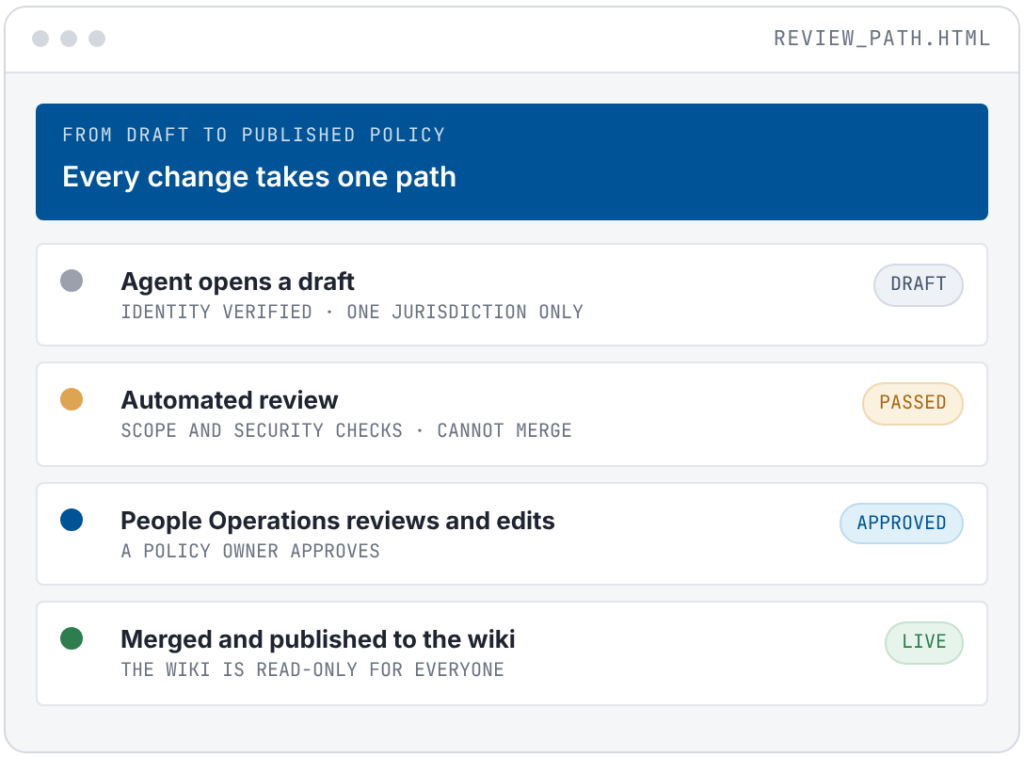
First, a handbook that machines can read. In September, the team moved every policy out of the wiki into plain-text Markdown files in a GitHub repository, which is now the single source of truth. Every change, from a person or an agent, arrives as a pull request (a proposed edit that is reviewed and accepted), and only designated policy owners can approve one. Approved changes are published back to the wiki, which nobody can edit directly. Automated checks look for contradictions, outdated job titles and formatting on every change, and a first audit led to 60 decisions applied across the North American policies. People Operations trained on the workflow in October. Team members now propose edits by describing them to Claude, and employees can ask Claude which recent changes apply where they work.
On that foundation, Oversight Otter runs one AI agent per jurisdiction on the 2nd of every month. Each agent works from a brief, checks what changed since its last run, sorts what it finds and compares it with the policy library.
01
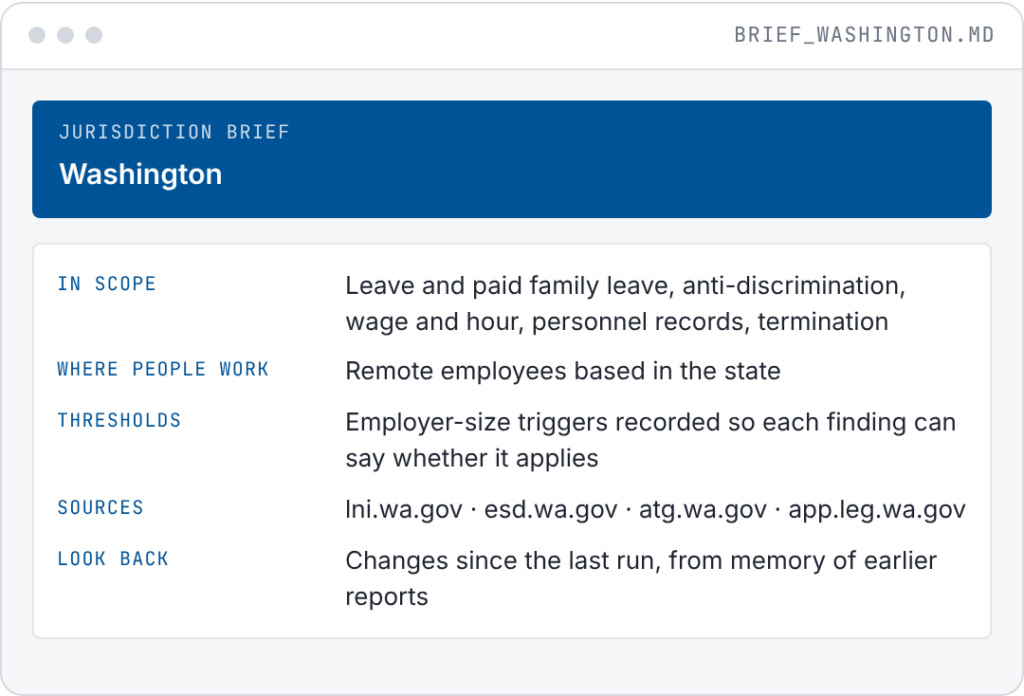
Each agent starts from a brief
What matters to us in this jurisdiction?
Every jurisdiction has a written brief covering the laws that matter, where people work, and the headcount thresholds that trigger obligations. In the proof of concept, briefs with these details made reports far more relevant than generic prompts did.
02
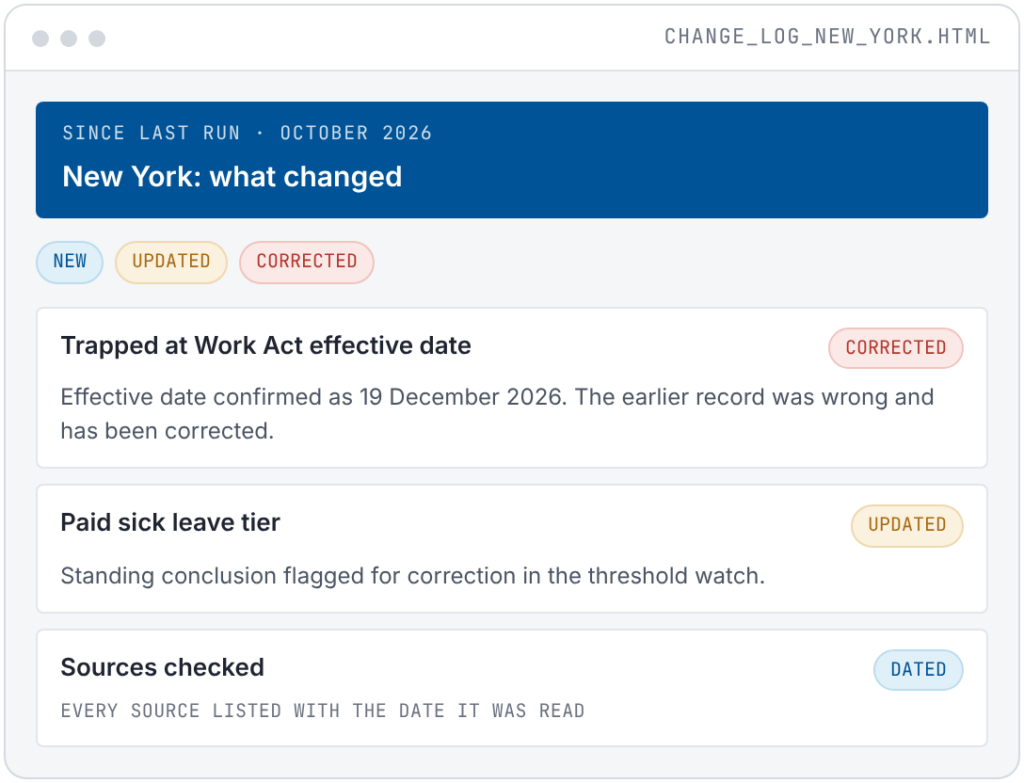
Agents check only what changed
What is new since last month?
Each agent keeps a memory of what earlier reports covered. It reviews the past month and reports the difference, from new laws and finalised rules to court decisions, pending bills and lawsuits worth watching.
When a later source shows an earlier note was wrong, the agent corrects its record in writing. In November, the New York report fixed the effective date it had recorded for a new law. It said plainly that the earlier entry was wrong.
03
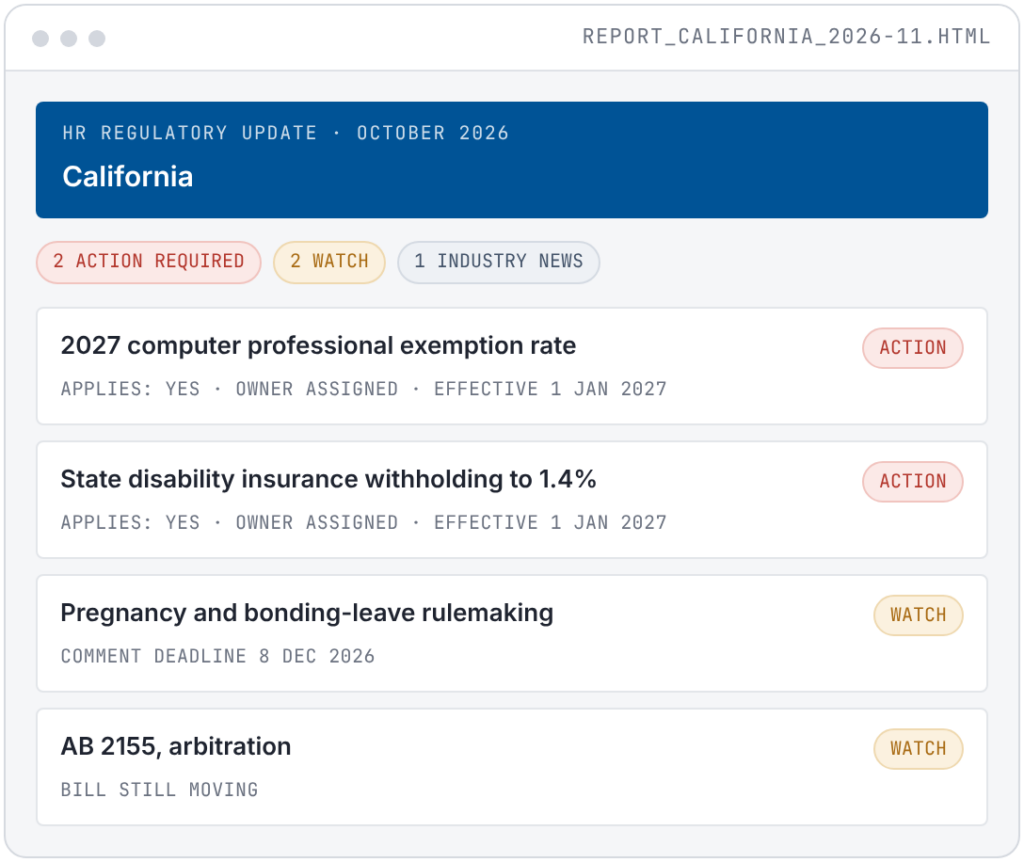
Every finding is sorted by urgency
What needs action, and by when?
Findings land in three groups. Action required items have an effective date and need a policy change. Watch items are bills or rules still moving. FYI items are early signals, such as a newly introduced bill or an ongoing lawsuit.
Each item says whether it applies to Aicadium and why, who owns it and when it is due. Each report lists the sources checked and the date of each check. Where a source is weak, the agent rates its confidence lower and says why.
The November run produced seven reports with 11 action items. They included New York’s Trapped at Work Act, which bans most “stay or pay” repayment terms from 19 December 2026. Another was Washington’s pregnancy accommodation rules, which take effect on 1 January 2027.
04
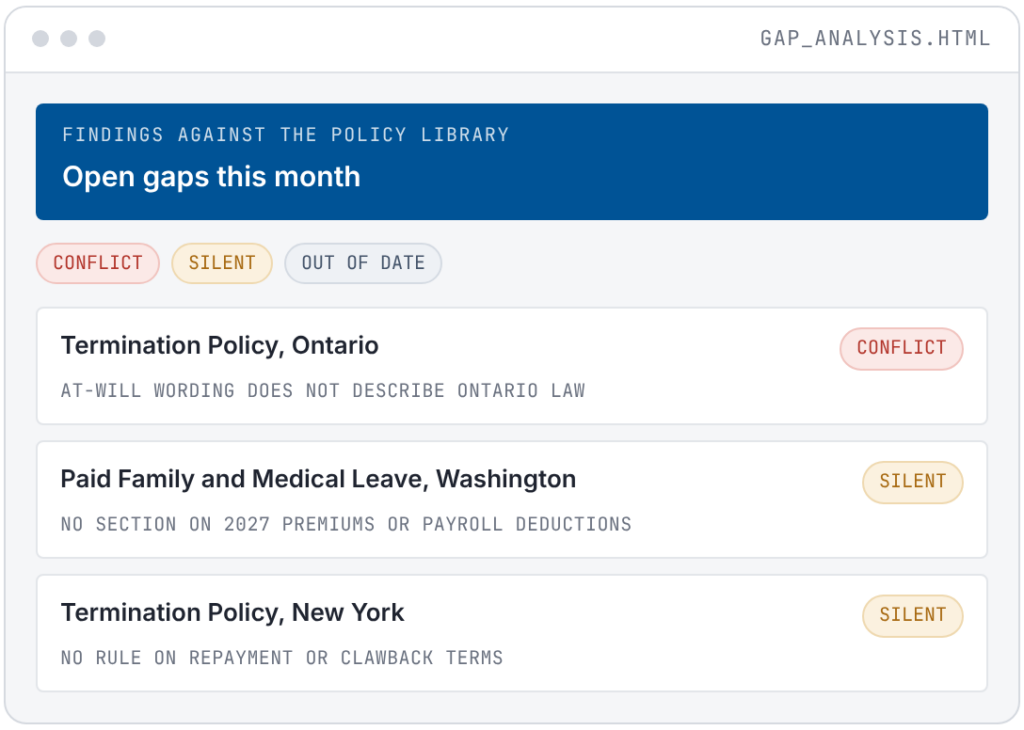
Findings are matched to the handbook
Where are we exposed?
When something changes at a portfolio company, the team refreshes the profile. SPARK re-verifies the stored facts and writes a change log of what is new, updated, or superseded, so the research compounds instead of restarting. Teams without agents can run the same comparison by hand, one handbook section at a time, with our handbook compliance review kit.
Put the findings to work
Downstream application
Once the gaps are known, the same findings drive the team’s actual work: drafting the change, deciding on it and tracking it to done.
05
Draft the policy change
What should the policy say now?
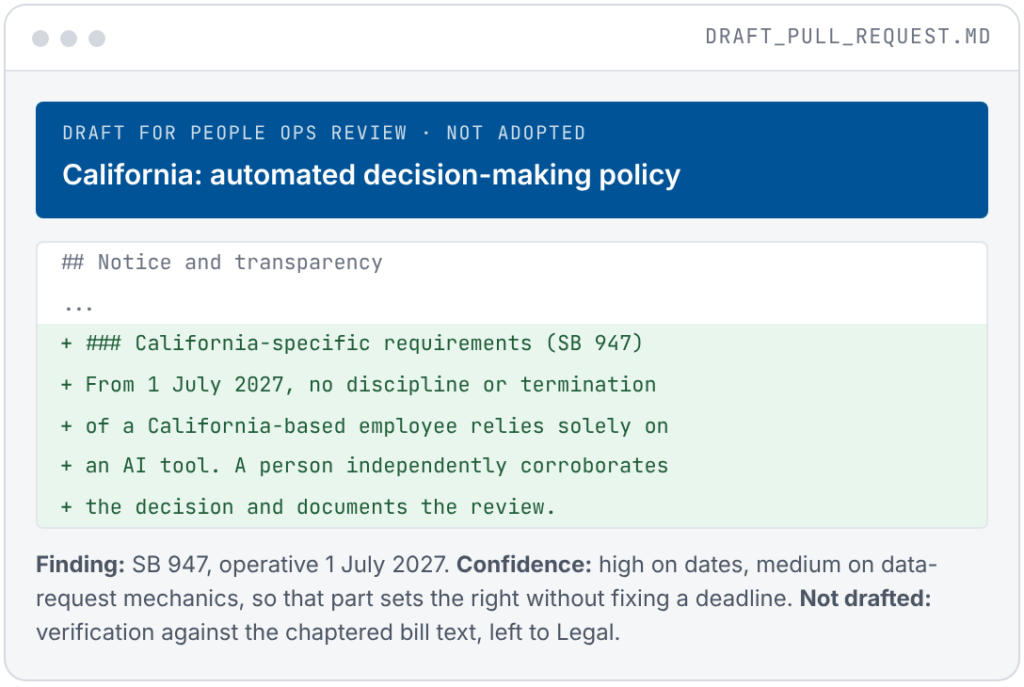
For each law that needs a change, a drafting agent writes the edit as a draft pull request in the policy library. Each draft names the finding it implements, the source, the exact text it changed and why. It also lists what it chose not to draft, such as a task for Legal rather than policy wording. Where a source is uncertain, the draft stays conservative and says so.
In October, the drafter picked up California’s Senate Bill 947 (SB 947), the No Robo Bosses Act. It drafted additions to the automated decision-making policy for California employees. From 1 July 2027, no discipline or termination may rest on an AI tool alone. A person must corroborate the decision. The team adopted that change more than eight months before the law takes effect.
06
Keep a human in the lead
Who decides?
The team says “human in the lead” rather than “human in the loop”. Knowing about a change is not enough in HR. A person still has to say yes to every policy that goes out.
The agents never publish. Every draft is marked as a draft for People Operations review. A team member reads it, adjusts the wording if needed (often by asking Claude to make the edit) and approves it. Only then does it merge and publish to the wiki. Findings that turn out not to apply are marked not applicable and cleared.
07
Track every finding to done
Who owns what, and is it finished?
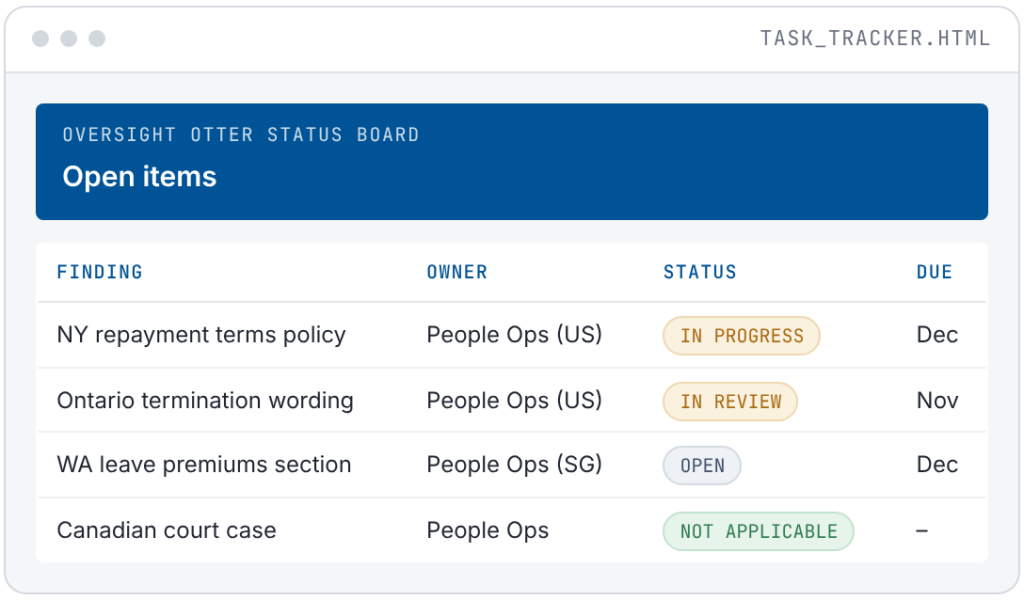
A dashboard reads each month’s reports and turns them into work. A heat map shows the month’s findings by jurisdiction, and the next deadline sits at the top. Every action item, open gap and draft gets an owner, a status and a due date. Each one links to the policy or draft in the library.
Colleagues in Singapore can pick up items assigned in the US the same night. The dashboard was built as a live artefact in Claude, in about 45 minutes of active work over three weeks.
What we learned
The first scheduled run stopped twice before it started
The first scheduled run stopped twice before it started. On 2 November, an update to the servers that run the agents broke the setup step before any agent started. Then a new step that reads the date was refused the one web page it needed. The first was fixed within hours, and the seven reviews were started by hand. All seven reports and five draft policies were published that day, and the second fix followed soon after.
Specific beats generic
Track the change, not the universe
Check every citation
Watch the plumbing
Give the agent your headcount, locations and thresholds.
A memory of last month keeps each report short.
AI can misstate a date or cite a bill that died. Every finding names its source, and a person checks it.
An unattended agent is only as reliable as the setup around it, so someone checks each run in the early months.
Value delivered
What changed for the team
~$6
~5x
1 week
in USD to run all seven agents each month, against the cost of one all-day seminar per person
faster per jurisdiction, from days of research and drafting to hours of review
each month for compliance work, instead of most of a month each year
What we learned
What changed for the team
Before
A twice-a-year scramble
- Updates followed the seminar calendar
- About 6 to 10 days of work per jurisdiction
- Close to a month from seminar to published policy
- Every policy change written from a blank page
- Policies edited directly in the wiki, with contradictions and stale details found by chance
- Employees searched the wiki for answers
- Seminar fees and days out of the office, about US$1,000 a year
After
A monthly routine
- A monthly scan. Seven jurisdictions checked on the 2nd of every month.
- Hours, not days. About 5 to 6 hours per jurisdiction, mostly reading and deciding.
- Published in the first week. Changes go live within days of the run.
- Drafts people adopt. 11 of 11 drafts from the October run adopted after human review.
- One reviewed path. Every change is a pull request with automated checks, and the wiki is ready-only.
- Answers for everyone. Employees ask Claude which policy changes apply where they work.
- A known running cost. US$6 a month, a higher first run while the agents read everything once US$11, and 3 to 6 days to build with the insfrastructure team.
Start where your team is
You do not need agents to begin
Many HR teams can run a monthly legal scan with a general AI assistant and a handful of prompts. Our handbook compliance review kit is the version of this routine, with six prompts, a five-minute verification check and a practice handbook. Oversight Otter is what that routine looks like once it runs on its own.