Aicadium partners with a global investment company to map AI opportunities across its portfolio
When research is spread across public sources, decks, notes, and individual knowledge, assessments can vary depending on how the research was conducted and how consistently the supporting evidence was recorded. Aicadium built a workflow with SPARK, our framework for verifiable AI research, that researches any company from public sources, scores each finding against its evidence, and turns the results into structured, reusable opportunity intelligence the team can act on, from internal prioritisation to vendor matching.
The problem
Opportunity research was scattered, inconsistent, and hard to trust
The investment team manages a broad portfolio and fields a continuous stream of vendor introductions. Identifying potential AI opportunities across the portfolio starts with understanding each company’s priorities, investments and market direction. This intelligence can then support subsequent assessment of relevant solution providers.
Fragmented information
Portfolio company information is fragmented across public sources and internal notes.
No reusable baseline
Follow-up discussions lacked a resuable baseline of structured intelligence, so research restarted whenever anything changed.
Difficult to scale
Researching each company to the same depth was difficult to repeat across a broad portfolio.
Inconsistent vendor formats
Vendor capabilities arrived in different formats and levels of details, which made them hard to compare.
Judgement-dependent matching
Matching vendors to relevant portfolio companies depended heavily on individual judgement.
Limited evidence traceability
Important findings and assumptions were not consistently linked to their supporting sources.
The solution
Build opportunity intelligence that the team can trust
Core SPARK capability
Aicadium developed the solution as a set of reusable AI workflows enabled by SPARK. At its core, SPARK does four things: structure the research, verify each claim in it, surface the opportunities it identifies, and refresh when the landscape changes.
01
Spark structures the research
What priorities and opportunity signals are supported by the available evidence?
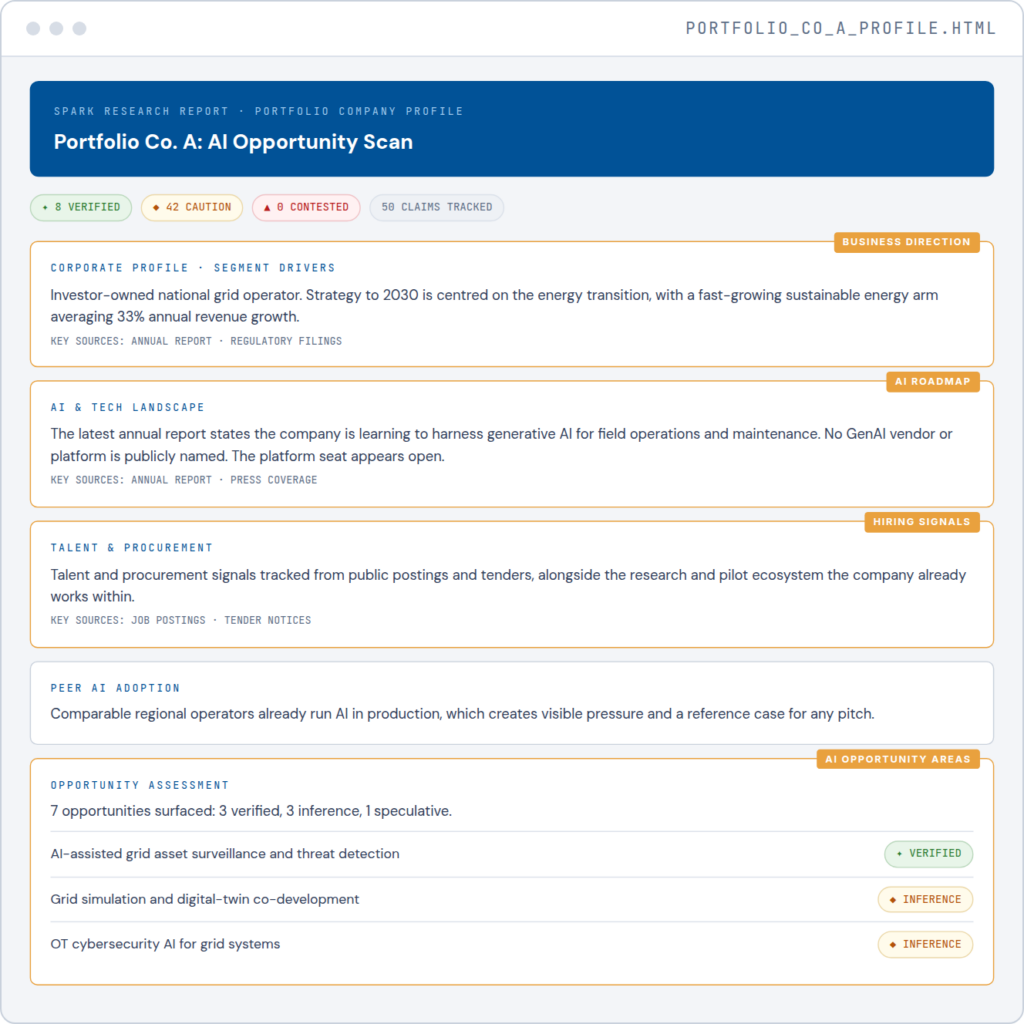
A custom SPARK recipe generated outside-in profiles for selected portfolio companies, built entirely from public sources. Each profile follows a consistent structure, creating a comparable and reusable intelligence baseline across the companies researched.
02
SPARK verifies each claim
How reliable is each finding?
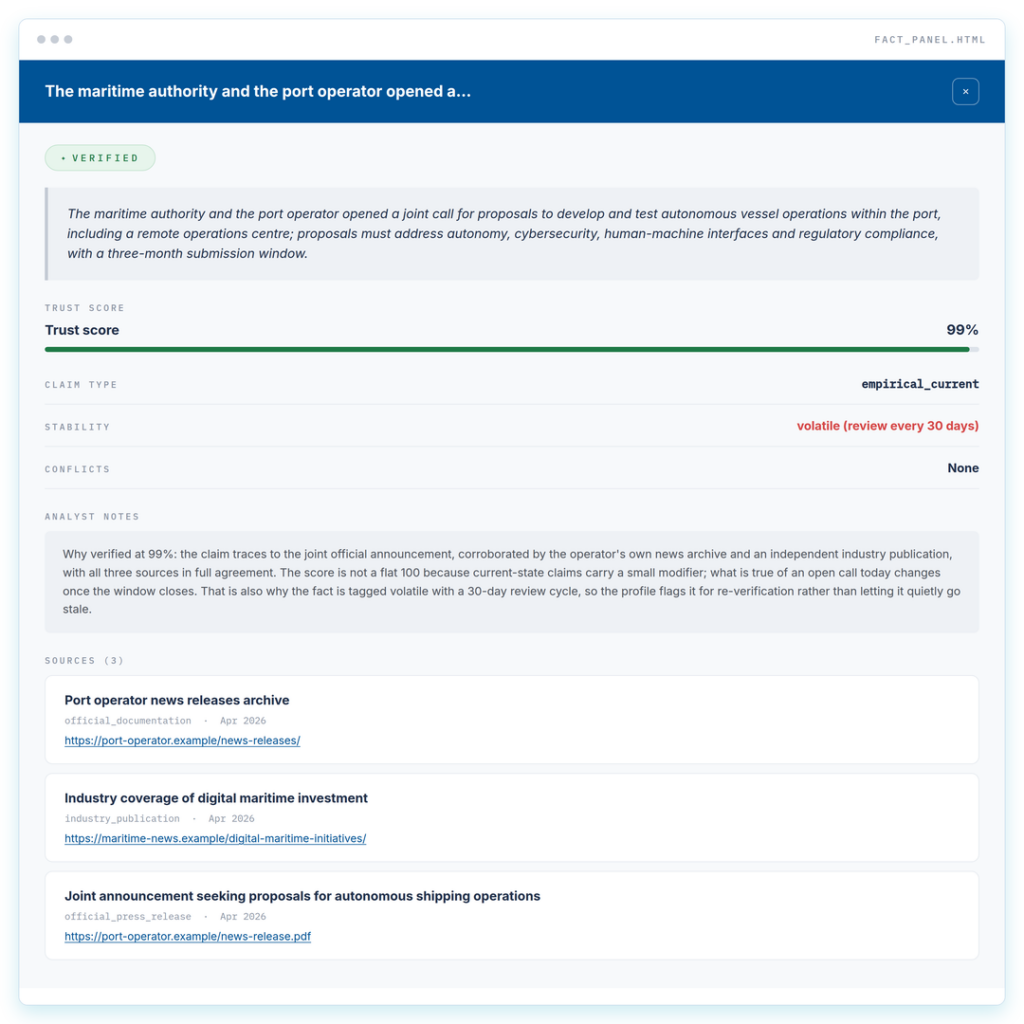
Each claim carries a trust marker, marked verified, caution or contested. The trust marker reflects the strength and consistency of the available evidence. Each profile also lists openly what it could not verify, so the team knows where the research ends and their own checking begins.
03
SPARK surfaces the opportunities
Where should the team look first?
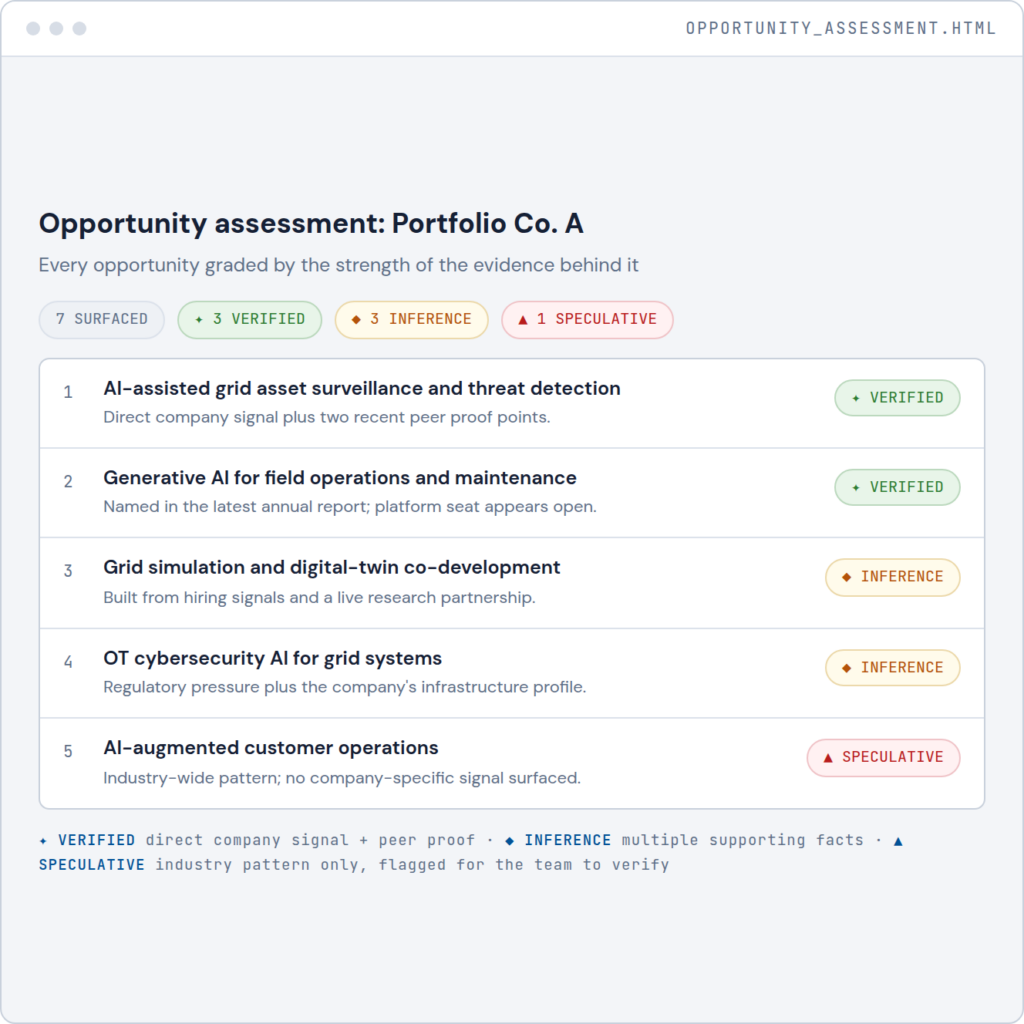
The workflow matches vendor capabilities against portfolio company signals and produces a ranked fit analysis. Each ranking comes with written reasoning: why the vendor fits the company’s stated priorities, what works against the pitch, and where the realistic entry point is.
The rankings are a starting point. The team reviews each recommendation and refines it with their own judgement, business context, and relationship knowledge before anything moves forward.
04
SPARK refreshes when the picture changes
How does the intelligence stay current?
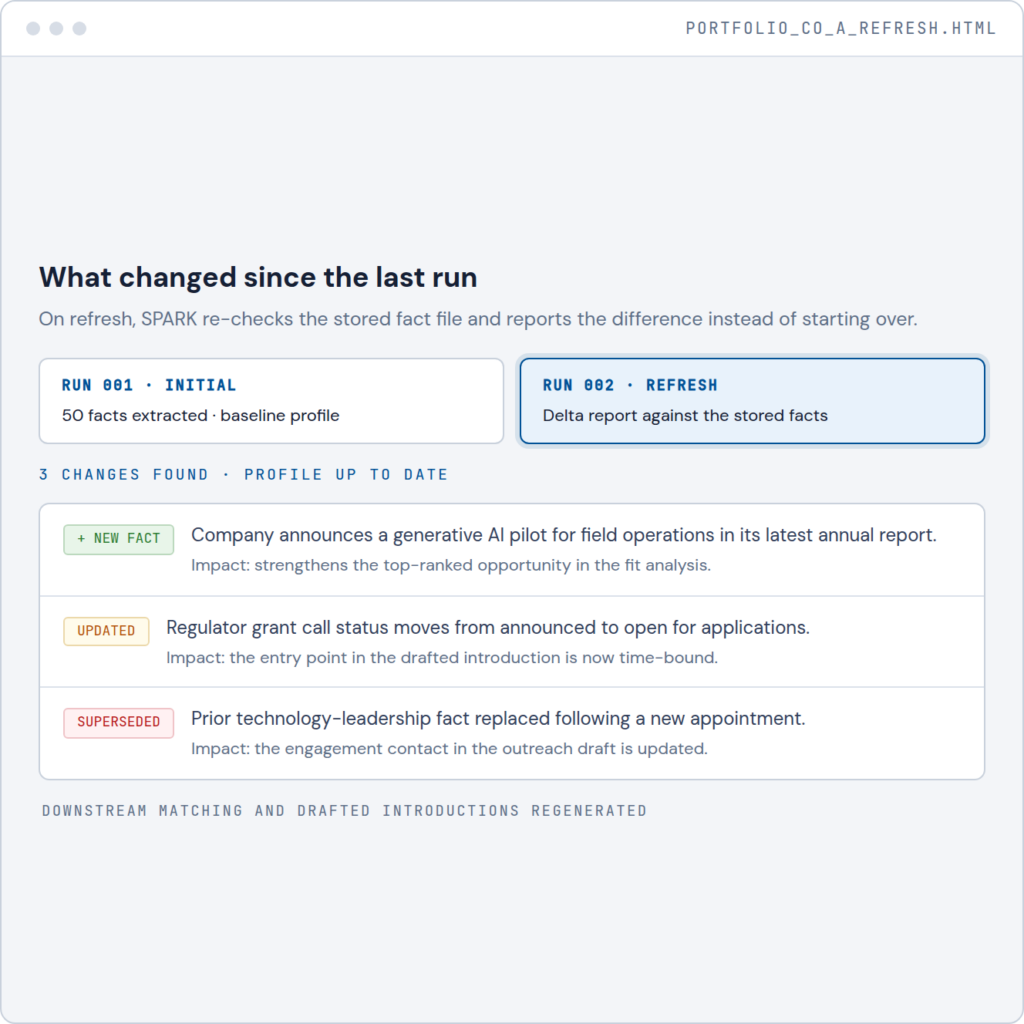
When something changes at a portfolio company, the team refreshes the profile. SPARK re-verifies the stored facts and writes a change log of what is new, updated, or superseded, so the research compounds instead of restarting.
Put the intelligence to work
Downstream application
With trusted profiles in place, the same intelligence drives the outputs that the team acts on. Vendor information is also structured into comparable capability profiles, allowing potential alignment to be assessed on a more consistent basis.
05
Compare vendors on one framework
What does each vendor actually offer?
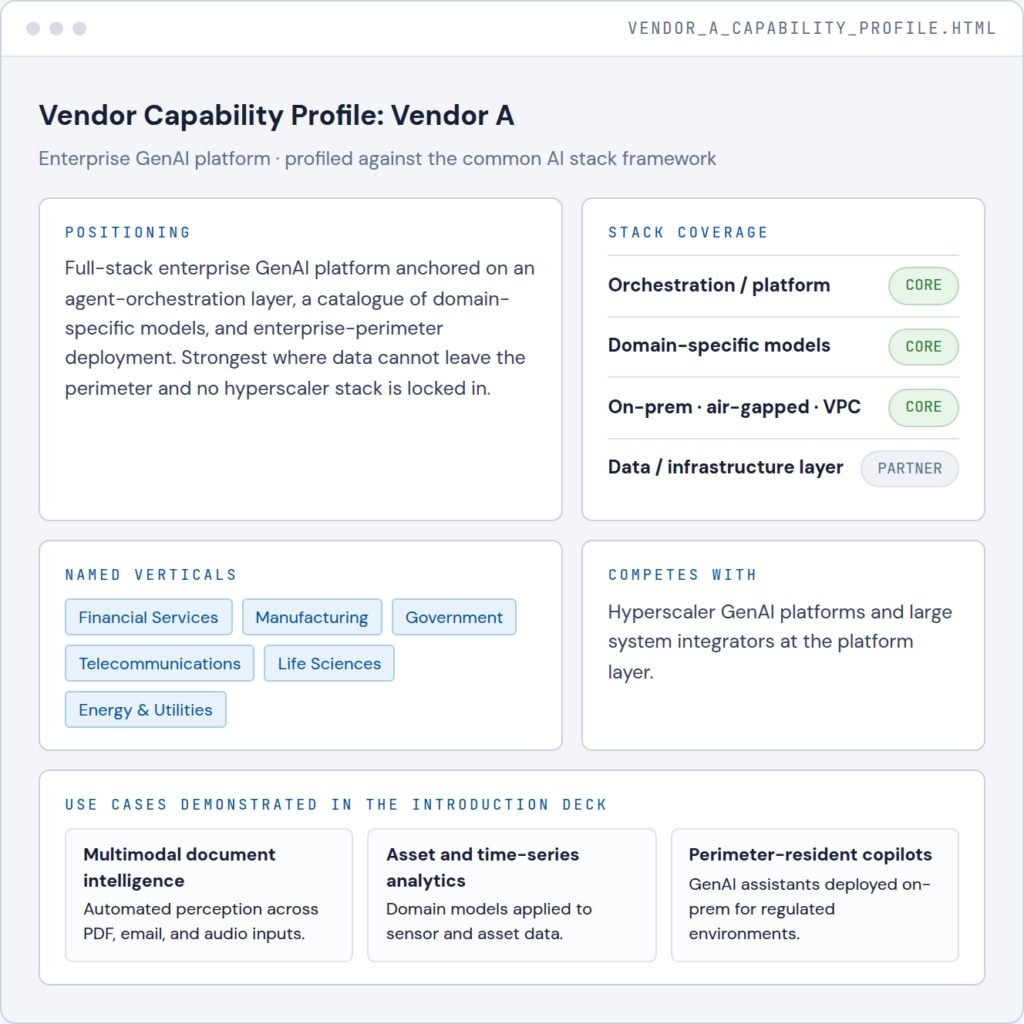
Vendor introduction decks and the team’s own meeting notes were restructured into vendor profiles that follow one baseline framework, organised against a common AI technology stack.
This allows vendor capabilities to be reviewed in a more consistent and comparable format: what each vendor builds, where that sits in the stack, and the use cases shown in its deck.
06
Match and rank with written reasoning
Where do vendors and companies meet?
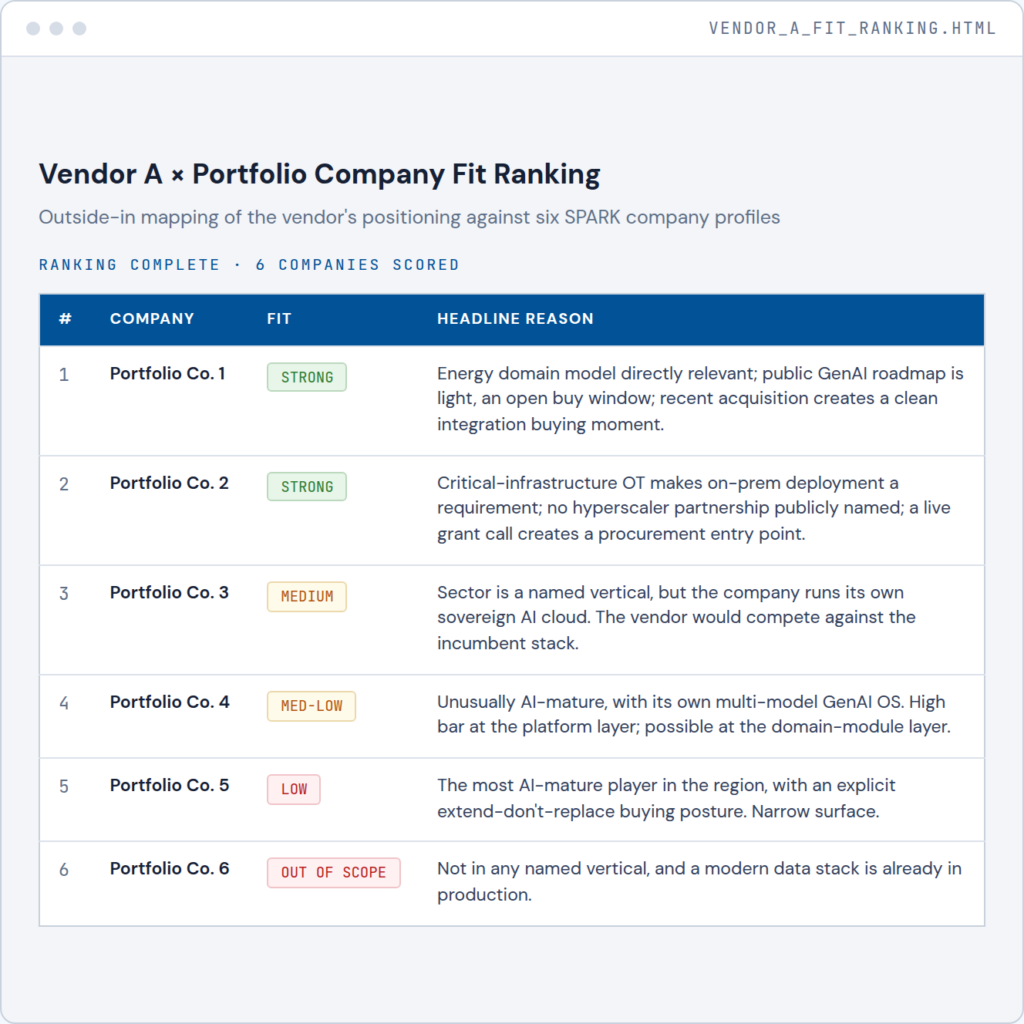
The workflow matches vendor capabilities against portfolio company signals and produces a ranked fit analysis. Each ranking comes with written reasoning: why potential alignment may exist, what evidence supports or limits that alignment, and what still requires validation.
The rankings are a starting point that the team reviews and refines with their own judgment, business context, and relationship knowledge before anything moves forward.
07
Support targeted engagement
What does the team actually send?
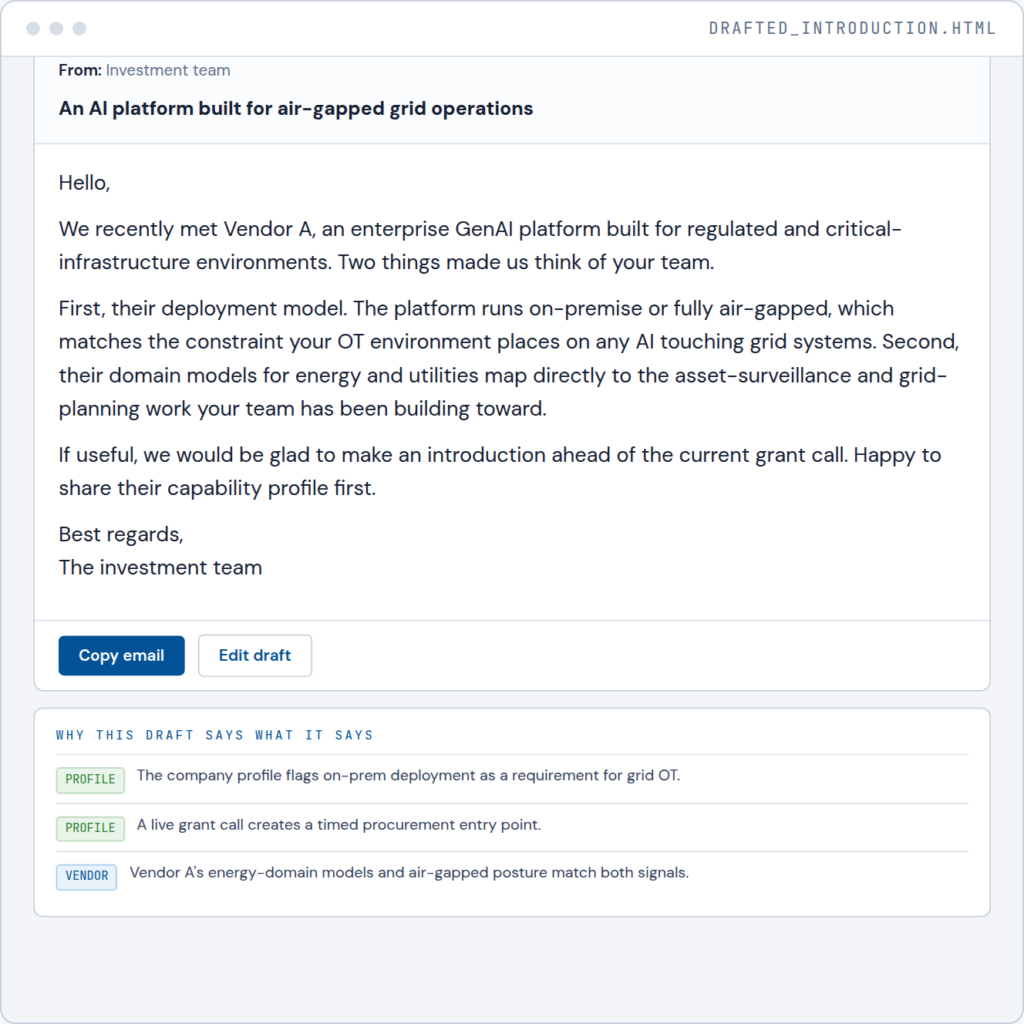
For the strongest matches, the workflow drafts an introduction email based on evidence from both profiles. Each line traces back to a fact in the company profile or the vendor profile.
For opportunities selected through the team’s review, the intelligence can also support evidence-backed introductions and more targeted engagement. A recommendation that once depended on someone’s memory now arrives as a documented, evidence-backed introduction. The team reviews it, edits it, and sends it from their own inbox instead of starting from a blank page, and the rationale behind every introduction is recorded in the same consistent way.
The same outputs feed internal prioritisation discussions, helping the team decide which vendor conversations deserve attention first.
Value delivered
What changed for the team
Before
Scattered intelligence
Company and vendor intelligence spread across decks, notes, and individual knowledge
Each vendor judged by whichever criteria its owner applied
Recommendations passed along by word of mouth
Research restarted from scratch whenever anything changed
After
Value the team can act on
One trusted view. A trust-scored profile for every portfolio company the team covers.
Consistent evaluation. Every vendor is assessed against the same stack framework.
Explainable recommendations. Each match carries written reasoning that the team reviews and refines before acting on it.
Compounding intelligence. A refresh re-checks the facts and reports what changed instead of starting over.
Powered by SPARK
Research teams can stand behind
The verified profiles of this project run on SPARK, Aicadium’s framework for AI research. Important claims are connected to their supporting sources and trust assessments, while profiles can be refreshed and rechecked as the underlying information changes.