
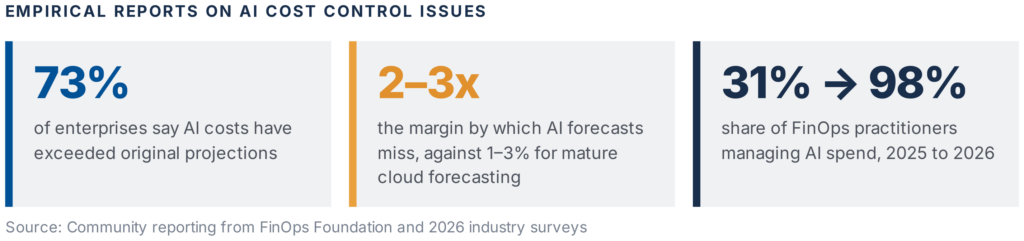
Industrial companies are approaching a familiar-looking decision: how much to spend on a new, rapidly evolving technology whose cost structure behaves nothing like the ones their planning processes were built for. FinOps Foundation data suggests mature teams forecast cloud spend within one to three percent and miss AI spend by a factor of two to three, and a majority of enterprises report AI costs have already exceeded original projections. For a finance function used to forecasting capex on a five-year depreciation schedule, this is a different discipline and not a bigger version of the old one.
Three forces are converging to accelerate AI spend for industrial companies:
-
Frontier model providers are moving away from bundled, subsidised token allowances toward committed-consumption pricing.
-
Agentic workloads that plan and call tools consume five to thirty times more tokens than an equivalent chat interaction.
-
A growing share of AI costs is embedded inside operational technology, where control-system, Manufacturing Executing Systems (MES), and industrial-SaaS vendors add AI features to renewal contracts.
That is not a reason to spend less. AI has already shown real operating leverage in industrial settings, delivering fewer unplanned outages, lower scrap rates, and faster technician ramp-up. For most industrial companies, the larger risk over the next two years is under-adoption. So the useful question is narrower: why is AI cost so hard to budget, and how do you keep adoption growing without letting the bill run wild?
The Four V’s Problem With AI Costs
Visibility: you cannot budget for what you cannot see. AI cost is rarely a single line item. It is buried in cloud bills, in vendor SaaS subscriptions that have quietly added AI features at renewal, and in team-level tool subscriptions that were not centrally procured. Industrial companies carry a second layer: operational-technology (OT) vendors are bundling AI-based analytics into plant-floor software, so a portion of “AI spend” shows up as an OT capital or in the maintenance line. The consequences are shadow AI and decentralised procurement, and the risk of sensitive plant, customer, or engineering data being uploaded to personal or unauthorised accounts. The compliance exposure can cost far more to remediate than the subscription itself.
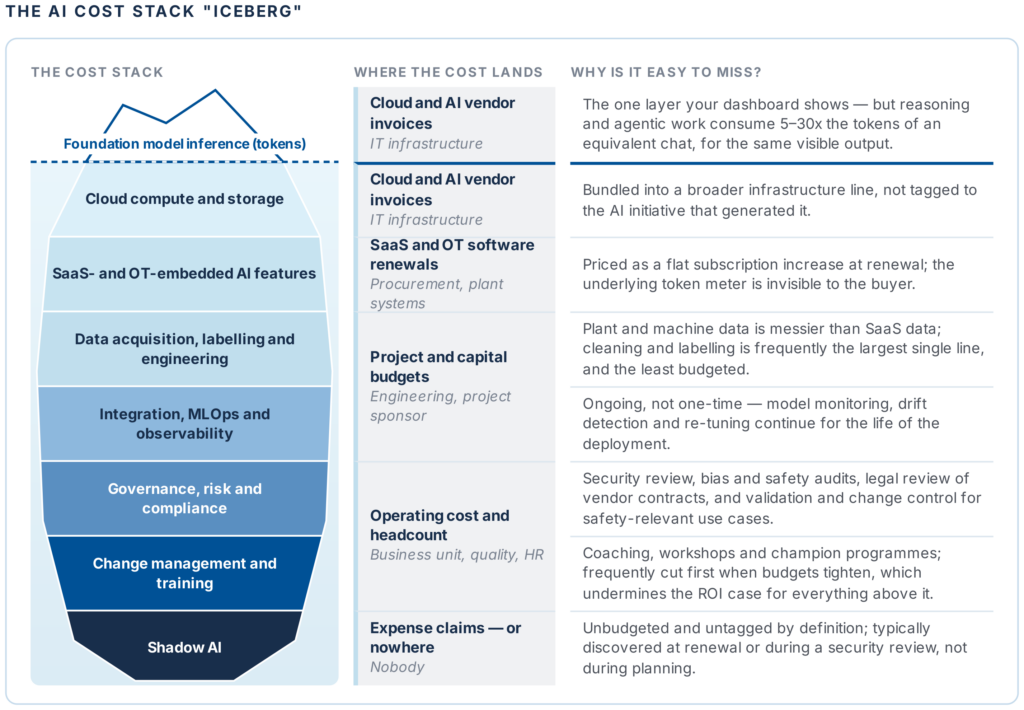
Variability: usage-based cost defeats seat-based forecasting. Traditional software is licensed per seat, and it is easy to forecast a year ahead. AI spend scales with tokens processed, API calls, and GPU-hours, which fluctuate with adoption, feature usage and how a prompt is written. A single query routed through a retrieval-augmented pipeline with a reasoning model can consume one to two orders of magnitude more tokens than a direct prompt to a smaller model, with no visible change in the end user’s experience.
Volatility: the ground moves under the budget you just built. Model providers change pricing, deprecate models, and release new ones on a cadence measured in months, not budget cycles. A model with a declining list price can still produce a rising bill because consumption grows faster than unit prices fall.
Value: attribution and ROI resist the old formula. AI’s productivity gains are often delayed or hard to isolate from other changes happening at the same time. Boards are asking for AI ROI with increasing urgency, and industry surveys show a wide gap between the share of executives who perceive gains from AI and the much smaller share who can confidently measure the financial return.
The common thread through all four is this: CFOs are being asked to budget for a cost category that behaves like a metered utility, using processes built for fixed, predictable IT costs. That mismatch is the main reason AI budgets consistently overrun across industries today.
How to Plan and Budget for AI Investments and Costs
The starting discipline is to stop treating “AI spend” as one budget category. There are at least two portfolios, each requiring different owners, approval processes, and success measures.
Improving something you already do has a “before” state, a measurable unit of value, and a reasonably short payback window, so budget it the way you already budget other productivity software.
Building a capability you do not yet have should be funded and governed like an R&D or venture portfolio: staged funding, iterative scope, and evaluation gates, rather than a single ROI number up front. Once approved, the budget is based on how costs behave, not on who asked for it.
After identifying the type of AI capability, the appropriate funding criteria and metrics discussed in our whitepaper should be considered to properly plan and stage the AI investment and level-set expectations on outcomes from AI investments.
How to Monitor Returns From AI Investments
Funding an initiative and proving it worked are two different disciplines, and the second is the harder of the two. For a tool that improves something you already do, you can measure the “before” and the “after.” For an investment that builds a capability you do not yet have, there is no “before” to compare against, because the capability did not exist. Applying a productivity-tool ROI calculation to that category will systematically undervalue it and can kill a good AI initiative.
For new-capability AI investments, early-stage bets will not show a financial return for some time, so track proxies instead: technical performance, real engagement, and progress against the roadmap. Financial ROI comes later, once the capability reaches operational scale. It validates the work and should not be the gate that decides whether early-stage work continues.
Keep the scoring honest; the team that built or bought the capability should not be the one that reports on its ROI. Finance should own the measurement framework and the baseline, captured before go-live rather than reconstructed afterwards.
Promoting AI Usage Without Letting Cost Run Wild
The goal is to make good usage of AI easy and visible, and to make waste visible and correctable, without defaulting to a blanket restriction as the primary control. The following are some suggestions on how to promote AI use in your organisation without letting costs go out of control:
-
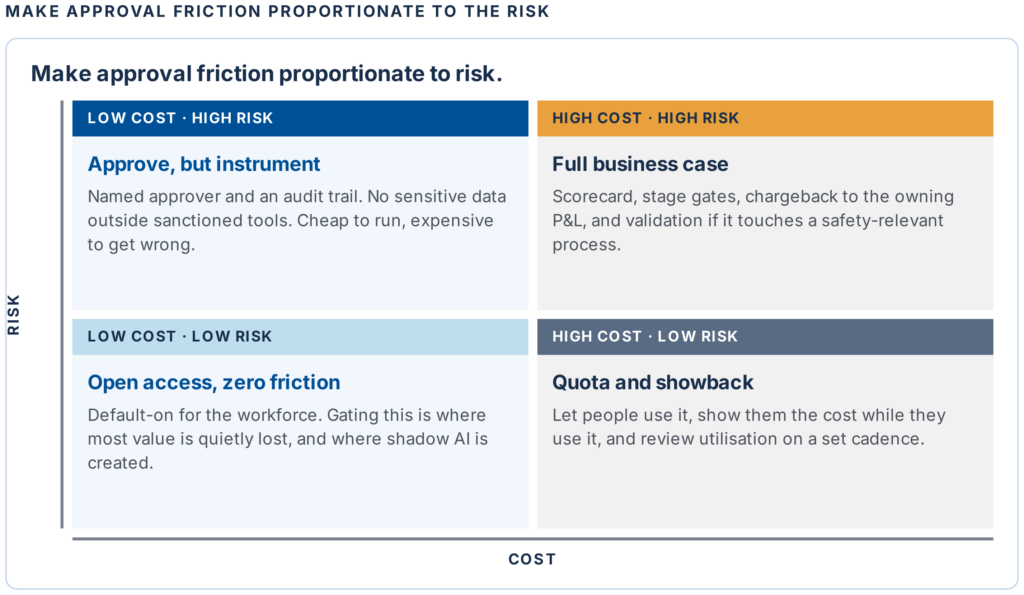
Design the access model in tiers. Make low-cost, low-risk tools broadly available with minimal approval friction. Gate higher-cost or higher-risk tools, such as API access, agentic systems, and anything connected to plant, customer, or safety data, behind a lightweight sign-off.
-
Tie budget to value, not headcount. Allocate a department’s AI budget against a metric that scales with expected benefit. This keeps the budget conversation anchored to what the spend is supposed to produce and gives a department justification to ask for more when it can show the growth in usage is earning its keep.
-
Make cost visible to the people generating it. Showback reports usage and costs back to teams while keeping expenses within a central budget. Chargeback assigns the cost to a department’s own budget, but requires mature usage tagging and finance alignment to split shared costs. Whichever you choose, the highest-leverage nudge is showing people the cost of what they are doing as they do it.
-
Pull the engineering levers before reaching for a cap. A meaningful share of token cost is addressable by the AI or engineering team without touching usage volume at all: model routing and cascading, prompt and context compression, semantic caching, compact structured output formats, and batching for workloads that do not need a real-time answer. Ask which have been applied before approving a use cap as the fix.
-
Put a governance structure around the whole system. Where the AI budget is significant, a proper cost governance structure, spanning finance, IT/engineering, and the business units, will be more effective in identifying and controlling AI spend than ad hoc caps.
AI spend will continue to behave like a metered utility for the foreseeable future: usage-driven, price-volatile, and hard to cleanly attribute to a business outcome. Hence, there is an urgent need to build a lighter, faster, more continuous governance model for AI investments, or risk falling behind competitors that successfully supercharge their processes with AI.
In our whitepaper, Planning for the Age of AI Tokens: The Industrial CFO’s Guide to Planning and Budgeting for AI, we set out ten measures a CFO can start adopting today. Around them sits the complete framework behind this piece: the Four V’s in full, the six questions to answer before funding any AI proposal, the staged funding gates and kill criteria that keep pilots from becoming zombie platforms, and the “cost per outcome” metric that replaces “hours saved” with something a board will accept.
Download it here to start with the ten actions