The blueprint was never the kanban board
Most companies that studied Toyota in the 1980s copied the wrong thing.
They saw the kanban boards, the just-in-time inventory, the Andon cord, and they imported the tools. What they missed was the thinking underneath them. Taiichi Ohno did not invent a set of techniques; rather, he invented a way of seeing, one that treated waste as a choice, continuous improvement as an obligation, and the people closest to the work as the most qualified people to change it. The companies that copied the tools without absorbing that philosophy got marginal gains and stalled. The ones that genuinely internalised it built advantages that took competitors decades to close.
That story feels very familiar right now, because the same mistake is being made with AI.
We wrote about Toyota two years ago, focusing on how computer vision was extending lean’s quality control logic into automated defect detection. It was accurate as far as it went. What we underestimated was the scale of what was already in motion. Toyota was rebuilding lean manufacturing around AI, using the same underlying philosophy Ohno developed seventy years ago to decide where AI should go, how it should spread, and what it should ultimately do to the organisation. The result is a blueprint for what AI transformation looks like when it is done with intention and enthusiasm.
The same philosophy in a new era.
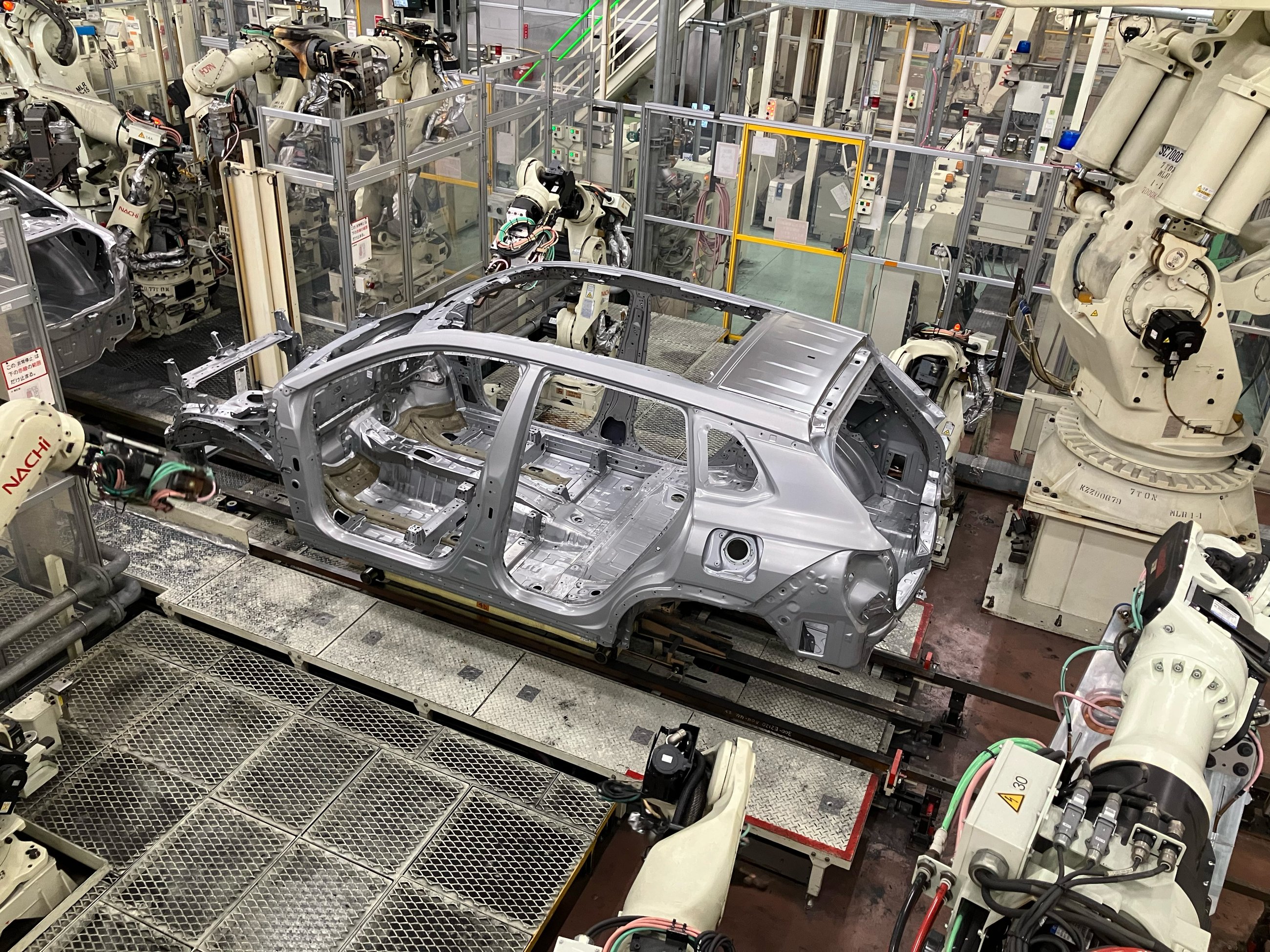
In 2022, Toyota’s Production Digital Transformation Office built a platform that enabled factory floor employees to create and deploy their own machine learning models regardless of technical background, removing the specialist bottleneck, as TPS had removed the foreman bottleneck decades earlier. By 2024, the platform was live across all of Toyota’s car and unit manufacturing factories (total of 10 factories)the number of AI models created had increased, and the approach was delivering a reduction of over 10,000 man-hours per year in the manufacturing process. The numbers matter less than what they represent: a company that understood AI capability had to be distributed, not held at the centre, if it was ever going to compound.
The next story highlights Toyota’s efforts to tap into its engineers’ knowledge.
Toyota’s powertrain engineers are among the most experienced in the automotive industry. They carry decades of accumulated expertise about engines, transmissions, emissions compliance, noise reduction, and fuel efficiency. They also retire. And when they do, that knowledge goes with them.
For an organisation built on the philosophy that waste is unacceptable, this represents an enormous and largely invisible problem. Expertise trapped in individuals cannot be shared, refined, or improved. It just disappears.
Toyota’s response is a generative AI system called O-Beya, named after the Japanese management concept for the collaborative room where cross-functional teams solve hard problems together. Built on Microsoft Azure and grounded in Toyota’s own engineering design reports, regulatory data, and handwritten documents from veteran engineers, O-Beya gives around 800 powertrain engineers access to a panel of specialised AI agents. It covers everything from engine performance to emissions regulation. Kenji Onishi, the engineer overseeing the project, explains the mission: to prevent the loss of knowledge when senior engineers retire.
One engineer using the system described looking up equipment specifications for measuring exhaust emissions, and being surprised at how detailed and accurate the answer was, noting that in the old days, the same search would have required tracking down the right document, reading through large volumes of text, and piecing together the answer manually. Ohno’s original idea was that wasting time searching for information isn’t productive, and O-Beya is here to eliminate that inefficiency.
The same logic is at work in Toyota’s supply chain. Jason Ballard, Toyota’s VP of digital innovations, described the company’s resource allocation process as historically built on 75-odd spreadsheets and more than 50 planners spending hours assembling monthly plans. Toyota is replacing that with an agentic AI system that reduces the planning team to 6-10 people, with the rest redistributed to higher-value work. An agentic system can now draft communications to logistics providers, update dealerships on delivery timelines, and flag vehicle delays before a planner arrives in the morning.
In 2025, Toyota formalised the full scope of this ambition to scale AI across the organisation with the launch of GAIA, a group-wide initiative to accelerate AI adoption across the entire organisation. GAIA will initially focus on 11 categories spanning manufacturing, robotics, vehicle engineering, customer relations, and knowledge retention, explicitly rooted in Toyota’s Jidoka principle: automation with a human touch. Running alongside it is a software academy offering over 100 courses to build AI capability across five Toyota Group companies. Tools and culture, built in parallel. Exactly what TPS required, and exactly what most organisations failed to do when they tried to implement lean on their own.
The mistake most companies are making
The organisations that tried to implement lean manufacturing and stalled did not pick the wrong tools. Instead, they treated lean as a project to be completed rather than a principle to be embedded into their organisation. They ran kaizen events without building a kaizen culture. They installed kanban systems without developing the discipline to sustain them. They measured activity, counting improvement events held and tools deployed, and mistook that for progress. The consensus that has emerged among operational excellence practitioners is pointed: companies that adopted technology without lean thinking ended up digitising waste rather than eliminating it, and lean should guide digital transformation rather than follow from it.
The same pattern is playing out with AI today, at a pace that gives organisations far less time to course correct.
The companies running the most AI pilots are not necessarily building the most durable advantages. The ones building durable advantages are asking the same question Taiichi Ohno asked on the factory floor: where is the waste in this value stream, what is preventing the people closest to it from eliminating it, and what infrastructure would allow improvement to compound over time rather than stall after the first win?
Those are organisational questions, and the reason most large corporations struggle to answer them well on their own is the same reason most manufacturers struggled to implement TPS on their own. The tools are visible. The philosophy underneath them is harder to see. And the distance between a successful pilot and a system-level transformation requires a kind of guidance that is very difficult to develop from inside the problem.
Toyota spent decades teaching the world its real advantage was never the kanban board. It was the thinking behind it.
The organisations applying that same lesson to AI today are building advantages that will be just as difficult for competitors to close as Toyota’s were in the 1980s. The time to build that thinking into your organisation is now, not after your next pilot.